
Closing the Gap: Why AI Agents Are the New Middleware Between Humans and ERPs
In the landscape of digital transformation, we have spent the last two decades chasing a singular goal: the “Paperless Office.” We implemented ERP systems like Odoo, SAP, and Oracle. We built intranets, dashboards, and complex workflows. Yet, despite this massive investment in technology, a fundamental bottleneck remains.
That bottleneck is the gap between human intention and system execution.
For the past year, I have been working on a project that aims to close this gap permanently. It combines my background in DOTID consultancy (the discipline of optimizing business operations), my experience in engineering AI agents, and the emerging architectural paradigm of multi-level multi-agent workflows.
The result is a 3BQ AI Agent—a data entry intermediary designed to sit between junior staff and the ERP system. But to call it a “data entry tool” would be like calling the first automobile a “horseless carriage.” It misses the profound structural shift that is about to occur.
This blog post is about what this project means for businesses today, and more importantly, what it means for the future of organizational hierarchy.
Part I: The Current State of the “Data Entry” Crisis
Every business, regardless of size, faces the same operational paradox: Seniors are expensive, and juniors are risky.
When a senior executive or a seasoned operations manager needs to update an ERP system—whether it’s logging a sales order in Odoo, updating inventory levels, or reconciling a financial statement—they know exactly what needs to be done. They understand the business logic, the taxonomy, and the implications of the data. However, their time is too valuable to spend clicking through forms.
This is where junior staff (or “juniors”) come in. We hire recent graduates or entry-level employees with limited experience, pay them a lower salary, and invest weeks or months training them on the intricacies of the ERP system. We ask them to translate simple reports (a Slack message, an email, a spreadsheet) into high-level, structured data entry.
The problem is that the translation layer is weak. Juniors make mistakes. They misinterpret context. They lack the “senior intuition” to know that a certain field, if left blank, will cause a downstream reporting error. Consequently, businesses face three chronic pains:
- High Training Overhead: It takes 3–6 months for a junior to become proficient in an ERP environment.
- Data Friction: There is a lag between when a business event occurs and when it is recorded in the system.
- Scalability Issues: You cannot scale operations without proportionally scaling headcount, which introduces geometric complexity in management.
Part II: The Solution—The 3BQ AI Agent as an Intermediary
What if we could change the nature of the “junior” role? What if we could eliminate the training bottleneck and the translation errors entirely?
This is the core premise of the project. We are deploying a 3BQ AI Agent to act as the intermediary layer between humans and the ERP system (specifically Odoo, due to its modular flexibility).
This is not a robotic process automation (RPA) bot that simply mimics mouse clicks. This is an intelligent intermediary powered by the advanced reasoning capabilities of Claude AI’s frontier model Opus 4.6 .
How it works in practice:
Imagine a junior sales representative, fresh out of university, with limited experience and minimal training. In the traditional model, you would spend two weeks teaching them how to navigate Odoo’s Sales module, how to distinguish between a “Quotation” and a “Sales Order,” and what to do when a customer has a special discount code.
In the AI-Intermediated Model, that same junior simply speaks or types naturally.
- Input: The junior sends a message: *“Hey, just got off the phone with Acme Corp. They approved the 100 units at $50 each, but they want net-30 terms and they need the order number by 2 PM.”*
- Processing: The 3BQ AI Agent parses this unstructured, conversational language.
- Reasoning: Using advanced LLM capabilities, it identifies the client (Acme Corp), the line items (100 units, $50), the payment terms (net-30), and the urgency (2 PM deadline).
- Execution: The agent logs into Odoo, creates the Sales Order, applies the correct pricing tier, sets the payment terms, flags it as urgent, and confirms back to the junior: “Order #1024 created for Acme Corp. Sent to fulfillment. Client will receive confirmation by 1:45 PM.”
The Economic Shift
For the business owner or the CFO, the math changes immediately.
You are no longer hiring juniors to be “Odoo operators.” You are hiring them to be human relationship managers and decision-makers. The junior’s low salary is now justified not by their ability to navigate complex software (which they can’t do yet), but by their ability to interface with clients and colleagues.
The AI agent supplies the “senior-level” execution.
- Cost Reduction: You reduce training costs to near zero.
- Error Reduction: You eliminate typos, field mapping errors, and forgotten steps.
- Speed: Data entry happens in real-time, not at the end of the day when the junior finally logs in.
Part III: The Architecture—Multi-Level, Multi-Agent Workflows
A single agent handling a single task is a toy. The real power of this project lies in its architecture: Multi-Level Multi-Agent Workflows.
In a complex organization, a single data entry task is rarely isolated. An invoice isn’t just an invoice; it’s a trigger for inventory updates, accounting reconciliation, and logistics coordination.
We are building a system where specialized agents communicate with each other to form a virtual operations department.
- The Interface Agent: Interacts with the human (junior). Speaks natural language. Translates “business speak” into structured data.
- The Validation Agent: Cross-references the input against historical data and business rules. “Wait, this client usually has a 20% discount. Did you approve that?”
- The Execution Agent: Interfaces directly with the ERP (Odoo). It has the API keys and the permissions. It writes the data.
- The Monitoring Agent: Checks the downstream effects. “The inventory for Item X is now below threshold. Triggering purchase order draft.”
By using multi-agent workflows, we move from “automating a task” to “automating a business process.” The human remains in the loop for approvals and exceptions, but the grunt work of moving data between silos disappears.
Part IV: The Future—Building the AI-Powered C-Suite
While the immediate value proposition of lowering costs and empowering juniors is compelling, it is only the first step. This project represents the foundational layer of something much larger.
We are currently in the early stages of building what I call the Second C-Level Management Layer.
Right now, the C-Suite (CEO, CFO, COO, CTO) is comprised of highly paid, highly experienced humans. Below them, you have directors, then managers, then seniors, then juniors. This pyramid is expensive and rigid.
Within the near future, DOtid (and similar consultancies leveraging this architecture) will be able to provide intermediate-level AI agents that slot into every position under the CEO.
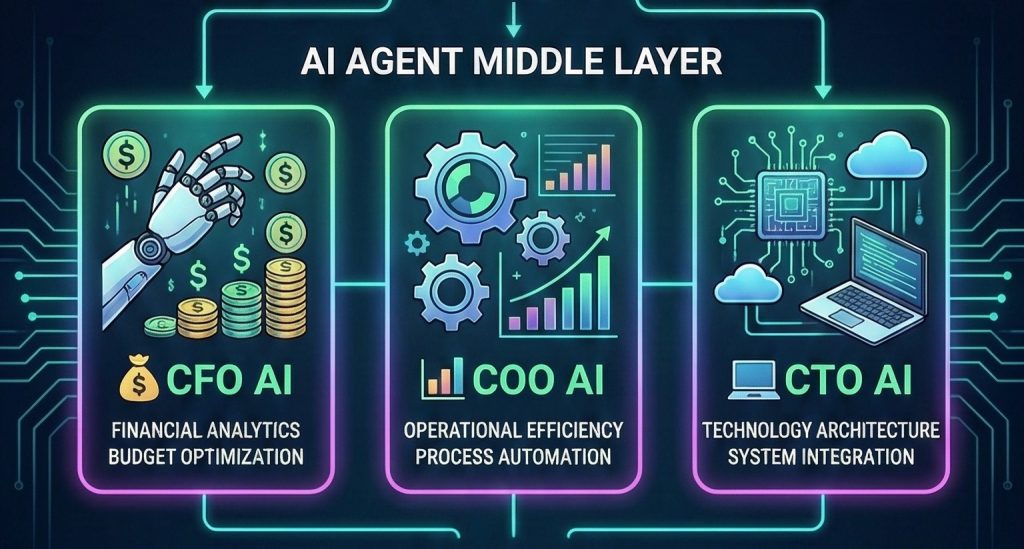
- The AI CFO: It won’t just enter invoices; it will monitor cash flow in real-time, flag anomalies, reconcile accounts nightly, and generate financial summaries for the human CFO to review in the morning.
- The AI COO: It will manage resource allocation, monitor operational bottlenecks across the ERP, and suggest workflow optimizations based on data trends.
- The AI CTO: It will manage API integrations, monitor system health, and even generate basic code patches or database queries based on high-level instructions from the human CTO.
The New Organizational Hierarchy
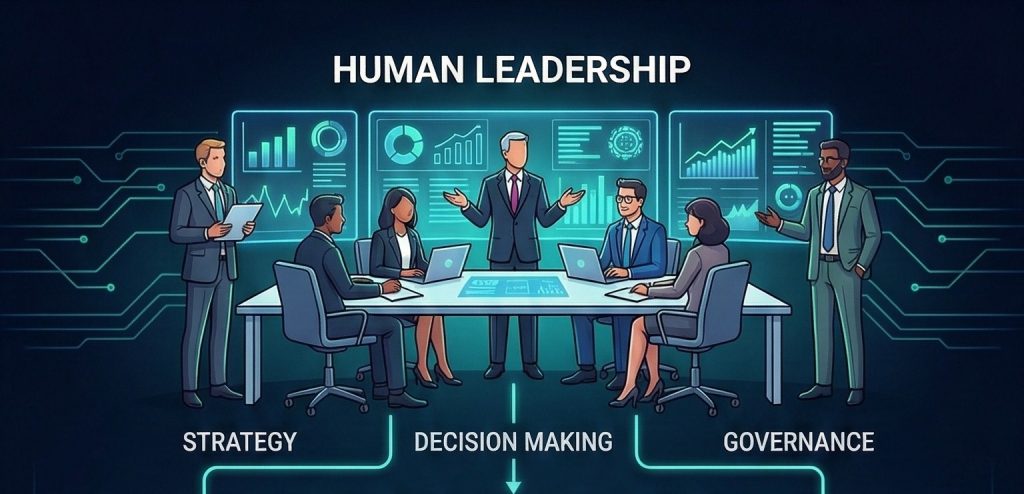
The future organizational chart will look like this:
- Top Level: Human Leadership. The CEO sets the vision, makes strategic pivots, manages investor relations, and handles high-level stakeholder management. Leadership remains fully human—because judgment, ethics, and vision cannot (and should not) be delegated.
- Middle Level: AI Agents (The Digital Middleware). This layer consists of specialized AI agents acting as CFO, COO, CTO, and department heads. They manage the complexity. They translate the CEO’s vision into operational directives. They manage the data flow and ensure the ERP reflects reality.
- Entry Level: Human Juniors (with AI Assistance). New entry-level employees now function as “conductors.” They use natural language to instruct the AI agents. They focus on creativity, customer interaction, and physical tasks that require a human presence. Their limited experience is no longer a liability because the AI provides the “senior-level” scaffolding.
Part V: Why This Matters for Your Business
If you are a business owner, a COO, or a digital transformation lead, this shift should fundamentally change your hiring strategy and your technology roadmap.
1. The End of “ERP Training”
If your hiring process currently values “Odoo experience” or “SAP knowledge” over critical thinking, you are optimizing for the wrong thing. In the AI-intermediated world, you hire for emotional intelligence, communication, and domain knowledge. The AI handles the system proficiency.
2. Operational Scalability
Traditionally, scaling from $10M to $50M in revenue required doubling the operations team. With a multi-agent AI layer, you can scale operations with a flat or minimally increased human headcount. The agents handle the transactional volume; humans handle the exceptions.
3. Data Integrity
The most valuable asset a company has is its data. When juniors make data entry errors, you are poisoning your own analytics. By having an AI agent that uses advanced reasoning to validate and map data before it enters the ERP, you ensure that your dashboards, financial reports, and forecasts are built on a foundation of clean, accurate data.
Conclusion: The Silent Operator
This project is not about replacing humans. It is about elevating them.
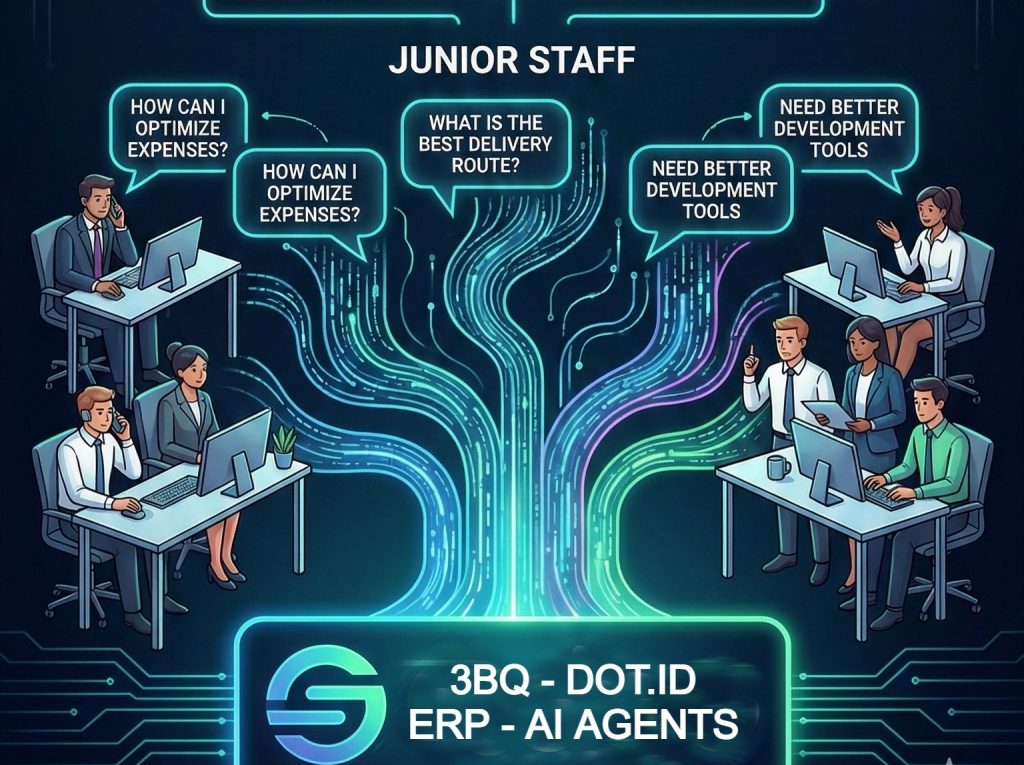
By positioning the 3BQ AI agent as the intermediary between junior staff and complex ERP systems like Odoo, we are removing the friction that has plagued operations for decades. We are allowing juniors to perform like seniors, not by making them work harder, but by giving them an AI co-pilot that handles the complexity.
In the long term, we are laying the groundwork for a new organizational structure—one where AI agents serve as the digital backbone of the C-Suite, managing the flow of operations while human leadership focuses on strategy and vision.
The era of the “AI Employee” is not a distant sci-fi fantasy. It is here. And it starts with reimagining the most mundane part of business: data entry.
If you are ready to stop training your staff on ERP clicks and start empowering them to focus on results, it is time to look at the agentic layer. The future of work is not human or machine; it is human and agent—working in harmony, with the agent handling the systems, and the human handling the business.
Welcome to the age of the AI Intermediary.